

It is only by addressing the challenge of income inequality that African countries can achieve decisive progress towards poverty reduction and the Sustainable Development Goals (SDGs), according to the United Nations Development Programme’s (UNDP) study on Income Inequality Trends in sub-Saharan Africa: Divergence, Determinants, and Consequences.
The publication, the first of its kind on Africa, was officially launched today during a high-level event on the margins of the 72nd session of the United Nations General Assembly.
The study indicates that in spite of solid economic progress over the last 25 years, illustrated by robust GDP growth of about 5.0 percent, poverty level remains very high in Africa – 41 percent compared to other developing regions. It further states adds that although sub-Saharan Africa (SSA) achieved an average reduction in its unweighted Gini coefficient—from about 0.47 to 0.43 between 1991 and 2011— the region remains one of the most unequal in the world – with 10 its counties listed among the 19 most unequal in the world.
According to the study, income inequality in African countries stems from a highly dualistic economic structure, where high income sectors, such as multinational companies and the extractive sector, offer limited capacity to generate employment compared to the informal sector, and where most of the workforce earns far lower incomes; a high concentration of physical capital, human capital, and land, especially in Eastern and Southern Africa; and the limited distributive capacity of the State, which often manifests in a ‘natural resource curse’, an urban bias of public policy, and ethnic and gender inequalities.
Immediate and underlying causes of inequality in SSA
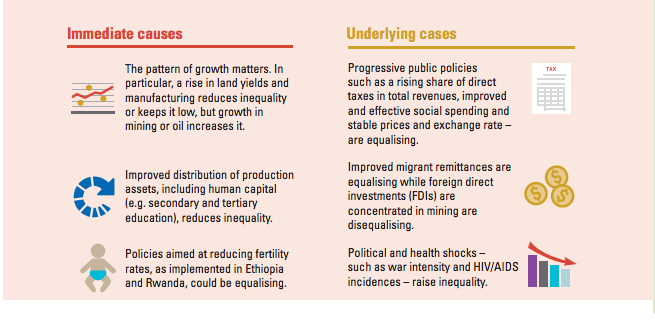
Building on an Integrated Inequality Dataset for sub-Saharan Africa (IID-SSA) the study explores the dynamics and complexities of income inequality to assert that seven outlier countries (South Africa, Botswana, Namibia, Zambia, Central African Republic, Comoros and Lesotho), all of which are marked by the concentration of land and socio-economic assets in the hands of a few, are leading the continent in income inequality, making the Africa’s Gini coefficient significantly higher than the global average.
On the other hand, Burkina Faso, Mali, Niger, Burundi, Guinea, appear to be performing better and rank among the most equal in the world. These countries are characterized by communal land ownership and egalitarian access to land, features which accelerate use of land for productive engagement, especially in agriculture.
Warning that there is no one-size-fits-all approach to addressing income disparities in the region, the authors of the book recommend a series of target policy approaches aimed at:
- •Improving distribution of human capital (particularly secondary education) to positively affect inequality;
- •Increasing direct taxation and efficiency of tax administration, as well as increasing well-targeted social expenditures;
- •Enhancing productivity in the agricultural sector, which is seen as key to reallocating labour to other sectors of the economy and reducing rural poverty, rural poverty gaps, and income inequality; and
- •Implementing structural transformation.
Planting the seeds of equity
Urging African policymakers to “plant and nurture the seeds of equity” the study recommends a far-reaching development strategy, symbolized by a Tree of Equity. Its 4 main ‘branches’ (population, macro-economic fundamentals, human development, and growth) are intended to facilitate Africa’s demographic transition; the adoption of macroeconomic policies to reverse deindustrialization; and greater productivity in the informal sector.
Income Inequality Trends in sub-Saharan Africa: Divergence, Determinants, and Consequences, is the product of research spanning over a period of two years. It was co-edited by Ayodele Odusola, Head of Strategy and Analysis and Chief Economist for UNDP Africa; Professor Andrea Giovanni Cornia of the University of Florence; Professor Haroon Bhorat of the University of Cape Town; and Pedro Conceicao, Director of Strategic Policy at UNDP’s Bureau for Policy and Programme Support.


