Fri, 10-Apr 2026

Search news articles
  • Home
  • AllAgricultureBankingAviationEnergyManufacturingTechnologyStartups
  • Geopolitics
  • Kenya Business NewsAfrican Business NewsGlobal News
  • Press Releases
  • Shows
  • Reports
  • Best Places to Work 2026
Subscribe
Events
Subscribe
  • Home
  • AllAgricultureBankingAviationEnergyManufacturingTechnologyStartups
  • Geopolitics

    Contact Us

    Media Queries & Partnerships:[email protected]

    About Us

    We are a leading integrated digital content platform providing in-depth business and financial news across Sub-Saharan Africa & the globe.

    Disclaimer

    The information contained in this website is for general information purposes only.
    © 2026 Wallstreet Africa Technologies LTD.. All Rights Reserved.
    1.0.32

    Private Sector Credit Growth Suffers Under Rate Capping Law Amid Rising NPLs

    Angeline
    By Angeline Mbogo
    - May 22, 2018
    - May 22, 2018
    Kenya Business news
    Private Sector Credit Growth Suffers Under Rate Capping Law Amid Rising NPLs

    The recent survey carried out by the Kenya Bankers Association (KBA) looking into the implications of the Banking (Amendment Act) 2016 indicates that private sector growth has slowed down.

    The Act has not altered the decreasing rate of private sector credit with the rate caps contributing towards the declining trend.

    According to KBA’s findings, private sector credit has reduced since the law was signed into effect in 2016.

    The Kenyan WallstreetHowever, the Association says the credit growth could have bounced back in January 2017 if the rate caps were not in effect.

    The survey also showed that non-performing loans (NPLs) have risen to double-digit levels as a proportion of gross loans while sensitivity to risk has increased due to the implementation of the IFRS 9 standard.

    In addition, there is limited access to credit by households and MSMEs. For instance, private household loans decreased from 25 percent at the end of 2016 to 20 percent at the end of last year.

    However, loans accessed by the real estate sector increased by two percent in the same period while total loans accessed by the manufacturing sector increased by three percent. That is to say that the rate capping law has favoured big businesses at the expense of MSMEs and households.

    Other findings indicate that government securities have remained attractive investment options thereby crowding-out the private sector. Moreover, the banking industry is leaning towards technology as a channel for delivering services to customers which has resulted in branch and staff rationalisation and affected local trade.

    The survey also observed short-term loans are increasingly becoming desirable, noting that the law does not augur well for the economy particularly because of the relationship between credit allocation and overall economic performance.

    “The market seems to be settling, but away from the intended beneficiaries of the capping law. […] The burden to the economy is increasingly becoming obvious,” the KBA findings report concludes.

    The Kenyan Wall Street

    We are a leading integrated digital content platform providing in-depth business and financial news across Africa & the globeSubscribe
    Loading...
    Loading...
    Loading...
    Loading...
    Loading...
    Loading...
    Loading...
    Loading...
    Loading...
    Loading...
    Loading...
    Loading...
    Loading...
    Loading...
    Loading...
    Loading...
    Loading...
    Loading...
    Loading...
    Loading...

    Your edge in markets, powered by AI

    Explore cutting-edge insights with our AI assistant, delivering real-time analysis, personalized news, and in-depth answers at your fingertips.

    Sign Up

    Show me today’s top trades

    Explain the market in simple terms

    What’s my next smart move?

    Report Issue

    Wall Street Africa Business Intelligence

    Access exclusive news, expert analysis, and tools designed to give investors an edge.

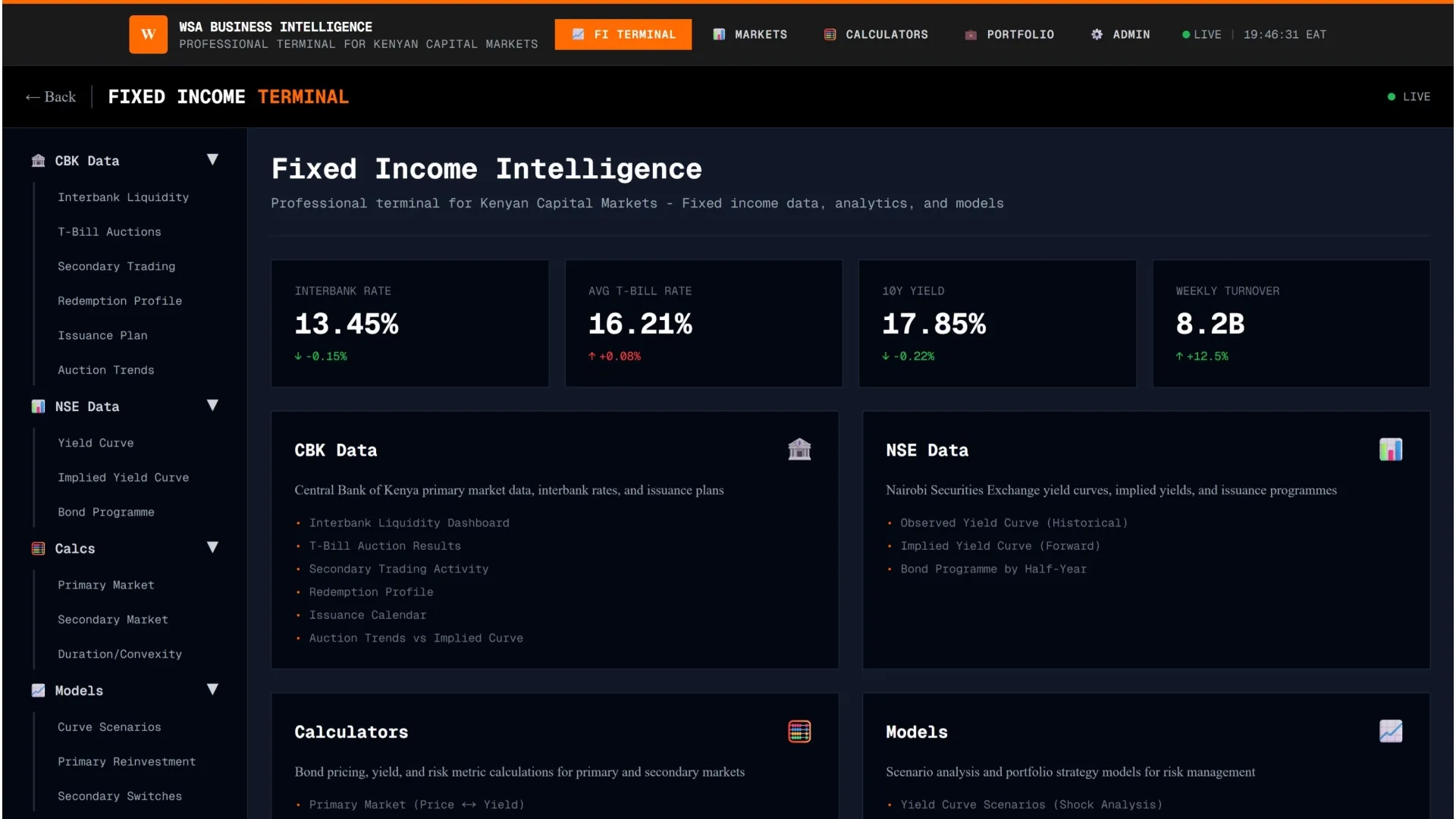
    Fixed Income

    Real-time bond pricing with instant calculations, auction data, yield curves, and trend analysis for Africa’s fixed-income markets.

    Local and Global Insights

    Unique perspective with a blend of local and global news and analysis, tailored for African investors.

    Real-Time Economic Indicators

    Monitor inflation, currency movements, and other key economic indicators for African countries.

    Interactive Data for Local Markets

    Visualize trends and compare markets across Africa with interactive charts and tools.
    Wallstreet Africa
    Wallstreet Africa
    Wallstreet Africa