

Millennials are a driving force behind the rise in car sales in Kenya, and there are several reasons why this is the case. Kenya has been experiencing steady economic growth in recent years, and this has led to an increase in disposable income among young people. Many millennials now have the financial means to purchase a car, and they are doing so in large numbers.
With the steady rise in car prices over the past 3 years, car owners have had to shelve the idea of disposing of their current vehicles with the fear of not being able to afford a newer one. This is the trend globally, with sellers in international markets such as Japan now holding their used cars longer than in previous years.
This shortage has caused an increase in the price of used cars with fuel-efficient cars like Toyota Vitz, Mazda Demio, and Honda Fit averaging slightly over a million shillings. For this price, car buyers in Kenya are slowly shifting towards buying locally used cars with a bigger engine capacity and being disposed of around the same price or slightly higher as a smaller vehicle that has been used foreignly.
The price increase is also attributed to newer features in cars like the hybrid and electric cars, as well as those with functional upgrades like cruise control, start-stop buttons, lane assist, and 360-degree cameras among other features, all contributing to higher prices than their previous models.
Millennials and Car Loans
Despite the country’s economic growth, many Kenyans are struggling with the high cost of living, causing them to pursue loan facilities in order to acquire newly imported cars. Data from the digital automotive financing marketplace, Autochek Kenya shows that last year, people born between 1981 to 1996 better known as millennials, accounted for 69 percent of vehicles purchased on loan.
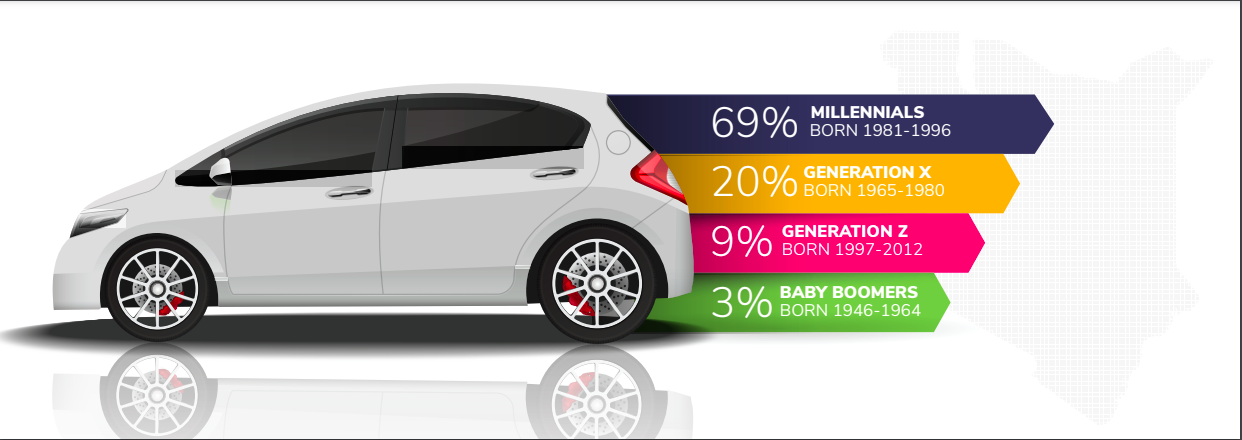
This could be attributed to the fact that most people at this age are already parenting and the need for a family car is very high. This pushes them to look for financing especially if they want a fresh import. This age group is also tech-savvy and environmentally conscious which triggers them to look for newer cars with fewer carbon emissions and more advanced features, like new hybrid vehicles which do not come cheap. The average cost of the cars they bought was Ksh. 1,700,000.
“From our data, millennials are more receptive to vehicles with newer technological features like hybrid and electric cars. This is due to their fuel efficiency capabilities coupled with advanced features in the vehicles.” Said, Autochek Africa’s Global Head of Marketing.
The data also shows that despite Toyota being the preferred car to buy, many of them went for luxury brands such as Audi, Porche, and Mercedes Benz, among others. “This is closely tied to millennials having access to loans that empower them with a bigger financial muscle” continued Michelle.
Generation X, who were born between 1965 and 1980 bought cars averaging 2.2 Million shillings and went for bigger vehicles with good ground clearance and like BMW X3 and X5, Subaru Outback, and Subaru Forester as well as new crossover SUVs. They accounted for 20% of cars bought from loans.
This could be characterized by most of them with kids in college, university, or just joining the workforce. Most of the people in this age group pursued cars with off-road capabilities, a possible indication that they are following up on their investments out of town as they plan for retirement.
Closely following was generation Z, who went for smaller cars ranging at 1.3M. Born between 1997 and 2012, people in this age group are buying their first car with their preference for Nissan, Toyota, and Suzuki cars.
Baby boomers bought the least amount of cars through loans. This could mean that most of them were cashing in their retirement funds and not requiring car loans as much as the other age sets.
The uptake of car culture in Kenya is also contributing to the rise in car sales. Owning a car for personal use, status, or personal expression is becoming more common. The rise of ride-sharing services such as Uber, Bolt, and Little Cab is also contributing to the rise as young people can now earn an income through ridesharing, and owning a car is becoming a necessity for those who want to participate in the gig economy.
ALSO READ; Kenya’s New Car Sales Fall 38.6% in the Year to August


