Wed, 11-Feb 2026

Search news articles
  • Home
  • AllAgricultureBankingAviationEnergyManufacturingTechnologyStartups
  • Geopolitics
  • Kenya Business NewsAfrican Business NewsGlobal News
  • Press Releases
  • Shows
Subscribe
Events
Subscribe
  • Home
  • AllAgricultureBankingAviationEnergyManufacturingTechnologyStartups
  • Geopolitics

    Contact Us

    Media Queries & Partnerships:[email protected]

    About Us

    We are a leading integrated digital content platform providing in-depth business and financial news across Sub-Saharan Africa & the globe.

    Disclaimer

    The information contained in this website is for general information purposes only.
    © 2026 Wallstreet Africa Technologies LTD.. All Rights Reserved.
    1.0.32

    KTDA tea production rises amid price decline

    The Kenyan
    By The Kenyan Wall Street
    - April 30, 2019
    - April 30, 2019
    Kenya Business news
    KTDA tea production rises amid price decline

    Cumulative green leaf production for smallholder tea farmers under Kenya Tea Development Agency (KTDA) rose to 868.9 million kilos in the first nine months of the 2018/19 financial year (July 2018 to March 2019), amid a19.5% drop in tea prices over the same period.

    This compares to 824.8 million kilos of green leaf delivered to KTDA-managed factories in the first nine months of the previous year FY (July 2017 to March 2018). However, the month of March 2019 recorded a decline of 25% compared to a similar month in 2018.

    “Despite the drought experienced in the last several months, high production of tea towards the end of last year continued to dampen the prices. The drought has recently led to reduced production and we anticipate this reduction could see prices improve as less tea volumes are offered for sale” KTDA Group CEO, Lerionka Tiampati said.

    The average price of KTDA teas in the first nine months of 2018/19 declined to USD 2.62 per kg from USD 3.25 for the corresponding period of 2017/18.Turbulence in the international markets such as economic sanctions imposed on Iran by the USA and high inflation rates in Egypt also negatively impacted the tea market.

    Compared to last year, the exchange rate dropped 1.6% as the Kenya Shilling strengthened against the dollar. Tea is traded in the US Dollar, which is then converted to KES.

    Other tea producing countries such as India also reported higher tea production in 2018 adding to global tea stocks which pushed prices down.

    “Despite the reduction in production due to drought, it is not anticipated that prices will improve significantly between now and the close of the financial year in June 2019. Farmers should therefore expect to receive lower total earnings for their produce this year,” Tiampati added.

    In October 2018, KTDA announced record income of Kshs85.74 million from the sale of tea supplied by smallholder tea farmers. A total of Kshs62.35 billion (representing 74% of income) was paid out to farmers as monthly and second payments.

    Related;

    Drought Affects Tea Production in Kenya

    The Kenyan Wall Street

    We are a leading integrated digital content platform providing in-depth business and financial news across Africa & the globeSubscribe
    Loading...
    Loading...
    Loading...
    Loading...
    Loading...
    Loading...
    Loading...
    Loading...
    Loading...
    Loading...
    Loading...
    Loading...
    Loading...
    Loading...
    Loading...
    Loading...
    Loading...
    Loading...
    Loading...
    Loading...

    Your edge in markets, powered by AI

    Explore cutting-edge insights with our AI assistant, delivering real-time analysis, personalized news, and in-depth answers at your fingertips.

    Sign Up

    Show me today’s top trades

    Explain the market in simple terms

    What’s my next smart move?

    Report Issue

    Wall Street Africa Business Intelligence

    Access exclusive news, expert analysis, and tools designed to give investors an edge.

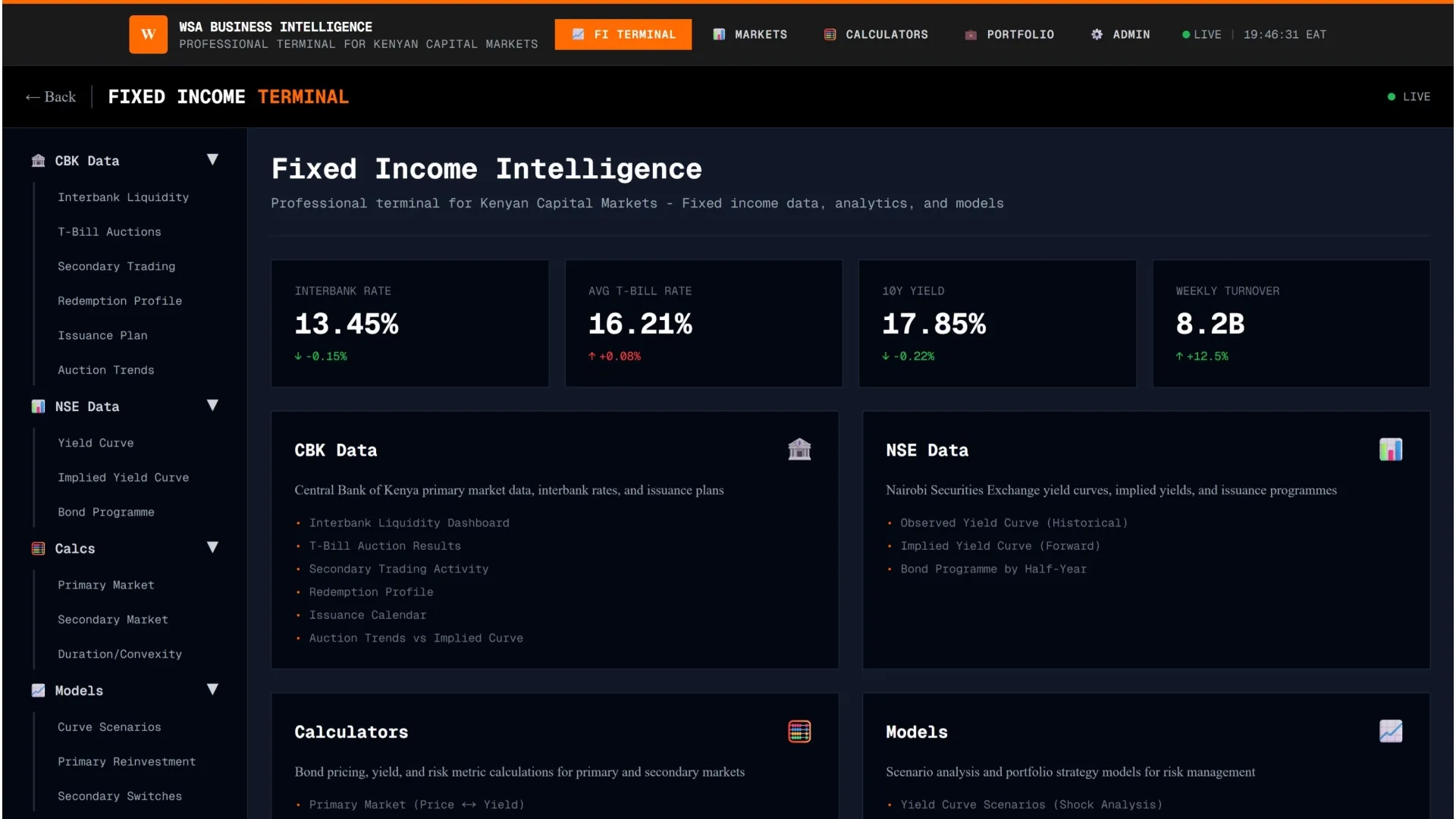
    Fixed Income

    Real-time bond pricing with instant calculations, auction data, yield curves, and trend analysis for Africa’s fixed-income markets.

    Local and Global Insights

    Unique perspective with a blend of local and global news and analysis, tailored for African investors.

    Real-Time Economic Indicators

    Monitor inflation, currency movements, and other key economic indicators for African countries.

    Interactive Data for Local Markets

    Visualize trends and compare markets across Africa with interactive charts and tools.
    Wallstreet Africa
    Wallstreet Africa
    Wallstreet Africa