
Wed, 18-Mar 2026

Search news articles
  • Home
  • AllAgricultureBankingAviationEnergyManufacturingTechnologyStartups
  • Geopolitics
  • Kenya Business NewsAfrican Business NewsGlobal News
  • Press Releases
  • Shows
  • Best Places to Work 2026
Subscribe
Events
Subscribe
  • Home
  • AllAgricultureBankingAviationEnergyManufacturingTechnologyStartups
  • Geopolitics

    Contact Us

    Media Queries & Partnerships:[email protected]

    About Us

    We are a leading integrated digital content platform providing in-depth business and financial news across Sub-Saharan Africa & the globe.

    Disclaimer

    The information contained in this website is for general information purposes only.
    © 2026 Wallstreet Africa Technologies LTD.. All Rights Reserved.
    1.0.32

    Kenya Q1 2017 GDP Slows To 4.7% as Agriculture Contracts for the First Time Since 2011

    The Kenyan
    By The Kenyan Wall Street
    - July 02, 2017
    - July 02, 2017
    Kenya Business news
    Kenya Q1 2017 GDP Slows To 4.7% as Agriculture Contracts for the First Time Since 2011

    The Kenyan economy in the first quarter of 2017 advanced by 4.7 percent in annual terms, compared to a 5.9 percent expansion in a similar period last year.

    The slowdown in growth was largely due to a 1.1 percent contraction in the activities of agriculture, negatively impacted by drought during the last quarter of 2016 and the first quarter of 2017. A slowdown in credit uptake also slowed economic growth during the period under review. There was a moderate buildup in inflationary pressures mainly due to significant increases in prices of food and beverages during the period under review.

    Agriculture sector contracted by 1.1% compared to an expansion of 0.1% in the previous period. The  contraction in agriculture was the first since 2011. The service sector, however, held up well. growth accelerated in the hotel & restaurant and wholesale & retail trade sectors. 

    Output growth slowed for transport and storage (9.9% from 10.4% in Q4 2016), real estate (9.6% from 9.7%), construction (8.4% from 11.5%) and education (5.9% from 6.3%). 

    Inflation averaged at 8.8 per cent thereby overshooting the Central Bank’s upper limit of 7.5 per cent.

    On the other hand, key macroeconomic indicators remained largely stable with interest rates dropping significantly as a result of the capping that became effective in September 2016.

    In the money market, the Kenyan Shilling strengthened against most of its major trading currencies. The most notable gain was a 12.1 per cent strengthening against the Pound Sterling. However, the Shilling weakened against the South African Rand, Yen and US Dollar during review period.

    Accommodation and food services sectors recorded the highest growth at 15.8 per cent from 10.4 per cent during the first quarter of 2016.

    The Kenyan Wall Street

    We are a leading integrated digital content platform providing in-depth business and financial news across Africa & the globeSubscribe
    Loading...
    Loading...
    Loading...
    Loading...
    Loading...
    Loading...
    Loading...
    Loading...
    Loading...
    Loading...
    Loading...
    Loading...
    Loading...
    Loading...
    Loading...
    Loading...
    Loading...
    Loading...
    Loading...
    Loading...

    Your edge in markets, powered by AI

    Explore cutting-edge insights with our AI assistant, delivering real-time analysis, personalized news, and in-depth answers at your fingertips.

    Sign Up

    Show me today’s top trades

    Explain the market in simple terms

    What’s my next smart move?

    Report Issue

    Wall Street Africa Business Intelligence

    Access exclusive news, expert analysis, and tools designed to give investors an edge.

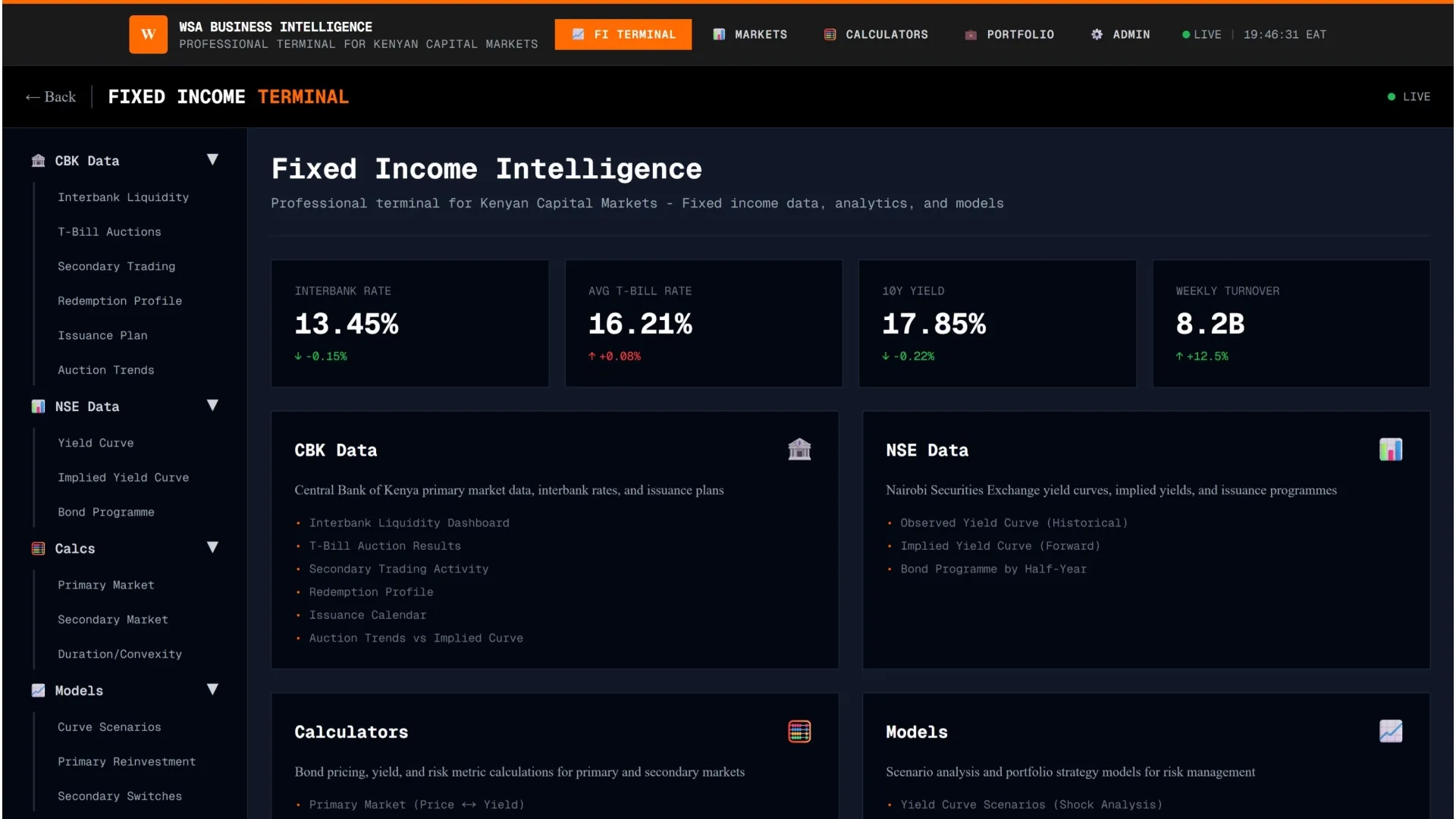
    Fixed Income

    Real-time bond pricing with instant calculations, auction data, yield curves, and trend analysis for Africa’s fixed-income markets.

    Local and Global Insights

    Unique perspective with a blend of local and global news and analysis, tailored for African investors.

    Real-Time Economic Indicators

    Monitor inflation, currency movements, and other key economic indicators for African countries.

    Interactive Data for Local Markets

    Visualize trends and compare markets across Africa with interactive charts and tools.
    Wallstreet Africa
    Wallstreet Africa
    Wallstreet Africa