Thu, 26-Feb 2026

Search news articles
  • Home
  • AllAgricultureBankingAviationEnergyManufacturingTechnologyStartups
  • Geopolitics
  • Kenya Business NewsAfrican Business NewsGlobal News
  • Press Releases
  • Shows
  • Best Places to Work 2026
Subscribe
Events
Subscribe
  • Home
  • AllAgricultureBankingAviationEnergyManufacturingTechnologyStartups
  • Geopolitics

    Contact Us

    Media Queries & Partnerships:[email protected]

    About Us

    We are a leading integrated digital content platform providing in-depth business and financial news across Sub-Saharan Africa & the globe.

    Disclaimer

    The information contained in this website is for general information purposes only.
    © 2026 Wallstreet Africa Technologies LTD.. All Rights Reserved.
    1.0.32

    Kenya Allocates KSh471 Million for Cooking Gas Subsidy

    Eunniah
    By Eunniah Mbabazi
    - April 25, 2022
    - April 25, 2022
    EnergyKenya Business newsPublic Policy
    Kenya Allocates KSh471 Million for Cooking Gas Subsidy

    Kenya has allocated KSh471 million to the stalled cooking gas subsidy scheme for the new financial year starting July, with the amount set to be raised to KSh820 million in the next financial year.

    This marks a 203% rise compared with the current financial year where KSh155 million had been allocated.

    In a draft budget released last year, the National Treasury Cabinet Secretary Ukur Yatani included a plan to distribute 300,000 six-kilogramme LPG cylinders to low-income households over the next three years.

    Under the initial cooking gas subsidy scheme, beneficiaries were to pay a discounted price of KSh2,000, in three years, for the burner and cylinder, with refills capped at KSh840 at the time.

    Presently, the 13kg cylinder retails at KSh3,400 from KSh2,250 in June before the government imposed the 16% VAT at the start of the current financial year. The six-kilogramme cylinder is retailing at KSh1,600 from KSh900 in June.

    The Ministry of Energy initiated the cooking gas subsidy scheme during the 2016/2017 financial year, seeking to cut reliance on environment-unfriendly kerosene and charcoal that are largely used in most rural and urban poor households.

    However, the implementation was hampered by some suppliers providing faulty cylinders and distribution challenges at the State-owned National Oil Corporation (Nock), which was to drive the programme.

    See Also:

    World Bank Skeptical About Kenya’s Fuel Subsidy

    The Kenyan Wall Street

    We are a leading integrated digital content platform providing in-depth business and financial news across Africa & the globeSubscribe
    Loading...
    Loading...
    Loading...
    Loading...
    Loading...
    Loading...
    Loading...
    Loading...
    Loading...
    Loading...
    Loading...
    Loading...
    Loading...
    Loading...
    Loading...
    Loading...
    Loading...
    Loading...
    Loading...
    Loading...

    Your edge in markets, powered by AI

    Explore cutting-edge insights with our AI assistant, delivering real-time analysis, personalized news, and in-depth answers at your fingertips.

    Sign Up

    Show me today’s top trades

    Explain the market in simple terms

    What’s my next smart move?

    Report Issue

    Wall Street Africa Business Intelligence

    Access exclusive news, expert analysis, and tools designed to give investors an edge.

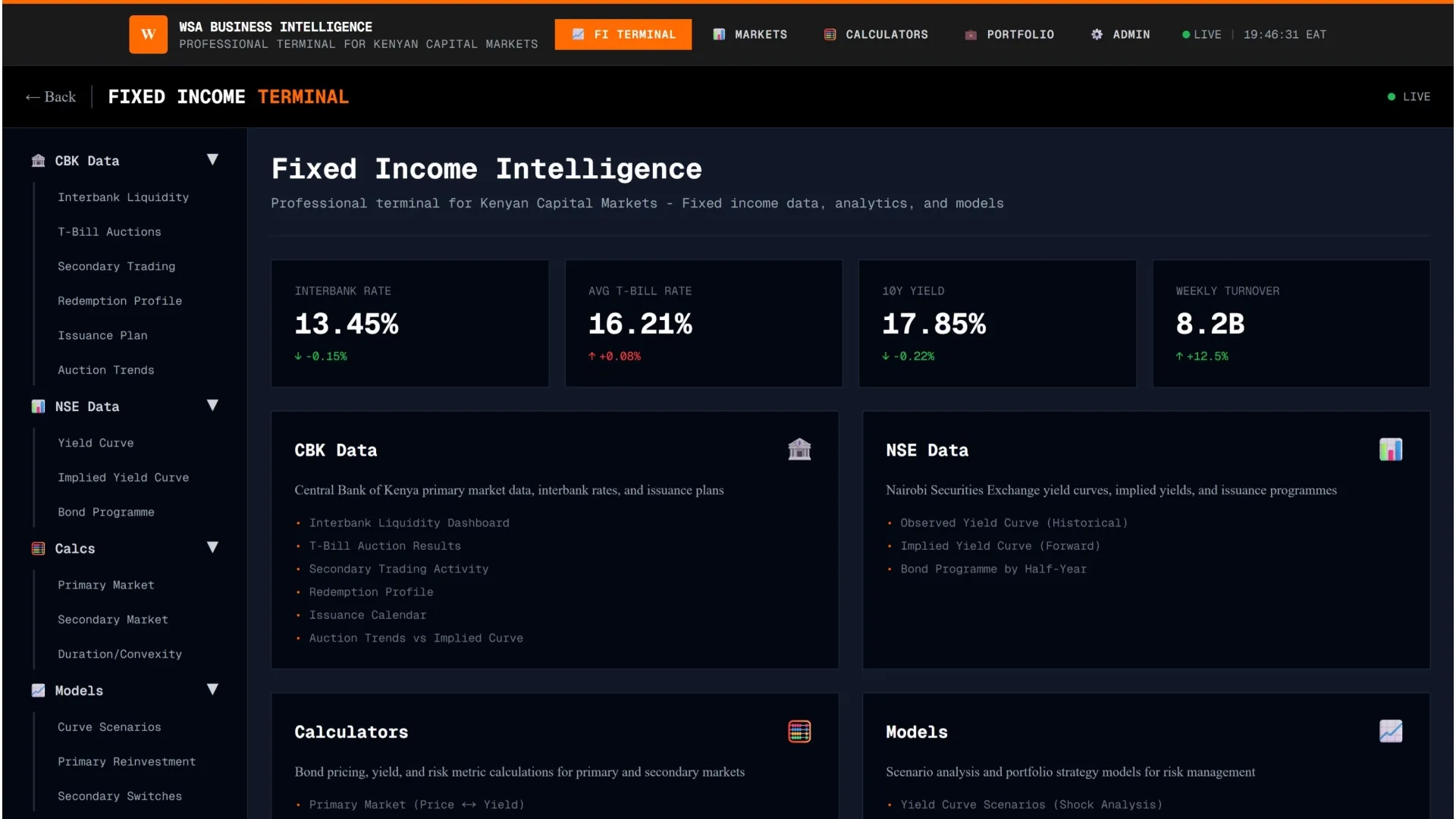
    Fixed Income

    Real-time bond pricing with instant calculations, auction data, yield curves, and trend analysis for Africa’s fixed-income markets.

    Local and Global Insights

    Unique perspective with a blend of local and global news and analysis, tailored for African investors.

    Real-Time Economic Indicators

    Monitor inflation, currency movements, and other key economic indicators for African countries.

    Interactive Data for Local Markets

    Visualize trends and compare markets across Africa with interactive charts and tools.
    Wallstreet Africa
    Wallstreet Africa
    Wallstreet Africa