

The global GDP growth is projected to slow down from 2.7 per cent in 2023 to 2.4 per cent in 2024, according to the World Economic Situation and Prospects (WESP) 2024 launched by the Economic Commission for Africa (ECA) in Addis Ababa, Ethiopia.
- •Growth is forecast to improve moderately to 2.7 per cent in 2025 but will remain below the pre-pandemic trend growth rate of 3.0 per cent.
- •The report indicates that developing countries face divergent near-term growth prospects.
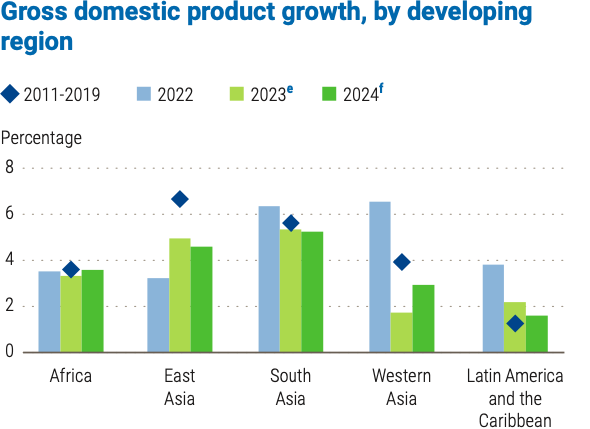
- •The economic growth in Africa he said is projected to remain weak, increasing from an average of 3.3 per cent in 2023 to 3.5 per cent in 2024.
Adam Elhiraika, Director, Macroeconomics and Governance Division of ECA said, tight financial conditions, coupled with a growing risk of geopolitical fragmentation, pose increasing risks to global trade and industrial production.
He said while the world economy avoided the worst-case scenario of a recession in 2023, a protracted period of low growth looms large. Growth prospects for many developing countries, especially vulnerable and low-income countries, have remained weak, making a full recovery of pandemic losses ever more elusive.
“The global economic slowdown, tighter monetary and fiscal conditions, and high debt sustainability risks will remain a drag on the region’s growth prospects,” said Mr Elhiraika.
“The unfolding climate crisis and extreme weather events will undermine agricultural output and tourism, while geopolitical instability will continue to adversely impact several subregions in Africa, especially the Sahel and North Africa.”
He noted that the world economy proved more resilient than expected in 2023 amid significant monetary tightening and lingering policy uncertainties worldwide, even as multiple shocks arising from conflict and climate change which will have an effect on the lives and livelihoods of millions, further jeopardizing progress towards sustainable development.
Inflation
The report says that after surging for two years, global inflation eased in 2023 but remained above the 2010-2019 average. Global headline inflation fell from 8.1 per cent in 2022, the highest value in almost three decades, to an estimated 5.7 per cent in 2023.
Hopestone Chavula, ECA Economic Affairs Officer who presented the report highlighted that although the global inflation is ebbing, food price inflation can exacerbate food insecurity and poverty. After surging for two years, global inflation eased in 2023 but remained above the 2010-2019 average.
“In addition to raising interest rates, the major developed country central banks started reducing the assets on their balance sheets, a process known as quantitative tightening, in 2022 and accelerated the pace in 2023 to reduce excess liquidity,” said Mr Chavula adding that the higher borrowing costs will exacerbate debt sustainability risks for developing countries.
Monetary tightening by major developed country central banks will have significant spillover effects on developing countries.
- •The report says the global investment trends will remain weak.
- •Global investment growth is likely to remain subdued.
- •Real gross fixed capital formation grew by an estimated 1.9 per cent in 2023, down from 3.3 per cent in 2022 and far below the average growth rate of 4.0 per cent during the period 2011- 2019.
International trade is losing steam as a driver of growth. In 2023, global trade growth weakened significantly to an estimated 0.6 per cent, a sharp decline from 5.7 per cent in 2022. It is expected to recover to 2.4 per cent in 2024, remaining below the pre-pandemic trend of 3.2 per cent. This slowdown, notes the report, is attributed to a slump in merchandise trade. By contrast, trade in services, particularly tourism and transport, continued to recover.
According to Mr Chavuka, Central banks worldwide are expected to continue facing a delicate balancing act and difficult trade-offs in 2024 as they strive to manage inflation, revive growth, and ensure financial stability. Central banks in developing economies will face the additional challenges of growing balance-of payments concerns and debt sustainability risks. Central banks must navigate a delicate balance between inflation, growth and financial stability.
On fiscal space he said it is shrinking amid higher interest rates and tighter liquidity. Sharp increases in interest rates since the first quarter of 2022 and tighter liquidity conditions have adversely affected fiscal balances, renewing concerns about fiscal deficits and debt sustainability. Countries implemented bold and timely fiscal policy measures in response to the pandemic crisis and to stimulate recovery.
- •The report says that industrial policy, which is increasingly seen as crucial for fostering structural changes and supporting a green transition is being revived and transformed.
- •This shift is aimed at fixing market failures and aligning innovation with broader development goals.
- •Innovation policies are also changing, with more ambitious, systemic and strategic approaches being employed.


