
Sun, 15-Mar 2026

Search news articles
  • Home
  • AllAgricultureBankingAviationEnergyManufacturingTechnologyStartups
  • Geopolitics
  • Kenya Business NewsAfrican Business NewsGlobal News
  • Press Releases
  • Shows
  • Best Places to Work 2026
Subscribe
Events
Subscribe
  • Home
  • AllAgricultureBankingAviationEnergyManufacturingTechnologyStartups
  • Geopolitics

    Contact Us

    Media Queries & Partnerships:[email protected]

    About Us

    We are a leading integrated digital content platform providing in-depth business and financial news across Sub-Saharan Africa & the globe.

    Disclaimer

    The information contained in this website is for general information purposes only.
    © 2026 Wallstreet Africa Technologies LTD.. All Rights Reserved.
    1.0.32

    EAC seeks to promote the regional automotive industry by restricting imports.

    Mwakaneno
    By Mwakaneno Gakweli
    - September 25, 2019
    - September 25, 2019
    African Wall Street
    EAC seeks to promote the regional automotive industry by restricting imports.

    The East African Community is working to promote regional capacity in the car manufacturing industry by taking measures against imports. The measures include locking out duty-free car imports from the Southern Africa Customs Union (SACU), as well as phasing down quotas on commodities.

    In a bid to control the level of imports, the region is considering growing the local automotive assembly industries as part of the regional value chain.

    READ ALSO: Three Kenyan banks fined by Tanzania Regulator for breaching anti-money laundering regulations

    SACU and EAC have different opinions regarding the Common External Tariff (CET) on car imports. On the one hand, EAC seeks to maintain the 25% tax, whereas the South African Customs Union (SACU) wants to waive the duty. Proponents from the EAC believe that the fee is necessary to protect local players and drive the regional value chain.

    “We have agreed to discuss the sector in terms of the regional value chain and not liberalization of motor vehicles coming from SACU,” Kenya’s Principal Secretary in the Department of Trade Chris Kiptoo.

    A review of the age limit for car imports.

    Cutting down on imported cars includes revisiting the age limit of second-hand cars to East Africa. Currently, Kenya allows imports of up to 8-year-old second-hand vehicles. On the other hand, other players in EAC have lower limits. Uganda has an age limit of 15 years, whereas Tanzania maintains an age limit of 10 years. 

    East Africa seeks to develop its capacity to suit its car needs. Last year, leaders at the EAC advised cuts on the importation of used vehicles to boost local competitiveness.

    Earlier this year, Kenya proposed to cut the age limit for car imports from 8 to 5 years, under the Draft National Automotive Policy. At the same time, the policy statement proposed a total ban on the importation of used full-body units.

    “Towards this, the age limit of imported passenger vehicles will be progressively raised, to expand the market for locally assembled vehicles… This will be implemented from 8 years to 5 years in 2019; from 5 years to 3 years in 2021 and; from 3 years to zero in 2023.” added the Draft policy.

    The Kenyan Wall Street

    We are a leading integrated digital content platform providing in-depth business and financial news across Africa & the globeSubscribe
    Loading...
    Loading...
    Loading...
    Loading...
    Loading...
    Loading...
    Loading...
    Loading...
    Loading...
    Loading...
    Loading...
    Loading...
    Loading...
    Loading...
    Loading...
    Loading...
    Loading...
    Loading...
    Loading...
    Loading...

    Your edge in markets, powered by AI

    Explore cutting-edge insights with our AI assistant, delivering real-time analysis, personalized news, and in-depth answers at your fingertips.

    Sign Up

    Show me today’s top trades

    Explain the market in simple terms

    What’s my next smart move?

    Report Issue

    Wall Street Africa Business Intelligence

    Access exclusive news, expert analysis, and tools designed to give investors an edge.

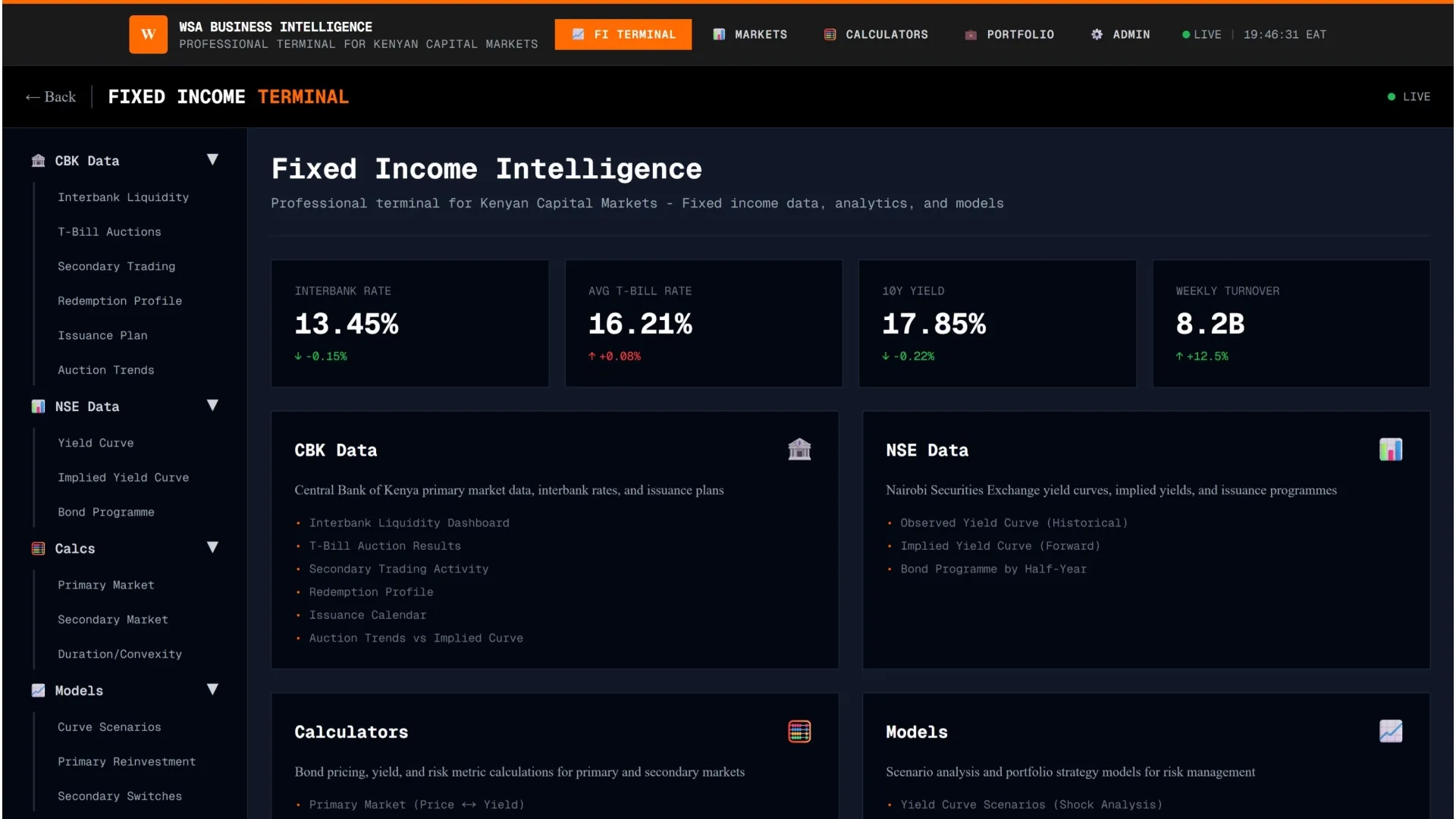
    Fixed Income

    Real-time bond pricing with instant calculations, auction data, yield curves, and trend analysis for Africa’s fixed-income markets.

    Local and Global Insights

    Unique perspective with a blend of local and global news and analysis, tailored for African investors.

    Real-Time Economic Indicators

    Monitor inflation, currency movements, and other key economic indicators for African countries.

    Interactive Data for Local Markets

    Visualize trends and compare markets across Africa with interactive charts and tools.
    Wallstreet Africa
    Wallstreet Africa
    Wallstreet Africa