Mon, 09-Feb 2026

Search news articles
  • Home
  • AllAgricultureBankingAviationEnergyManufacturingTechnologyStartups
  • Geopolitics
  • Kenya Business NewsAfrican Business NewsGlobal News
  • Press Releases
  • Shows
Subscribe
Events
Subscribe
  • Home
  • AllAgricultureBankingAviationEnergyManufacturingTechnologyStartups
  • Geopolitics

    Contact Us

    Media Queries & Partnerships:[email protected]

    About Us

    We are a leading integrated digital content platform providing in-depth business and financial news across Sub-Saharan Africa & the globe.

    Disclaimer

    The information contained in this website is for general information purposes only.
    © 2026 Wallstreet Africa Technologies LTD.. All Rights Reserved.
    1.0.32

    Global Cereal Prices are Unlikely to Decline in 2023-IMF

    Rosemary
    By Rosemary Muthoni
    - December 14, 2022
    - December 14, 2022
    AgricultureGlobal News
    Global Cereal Prices are Unlikely to Decline in 2023-IMF

    Global cereal prices are unlikely to drop in the next six to 12 months, according to a projection by the International Monetary Fund.

    According to the fund, this will not provide the anticipated relief to many people who had hoped for a decrease in cereal prices.

    Global food prices are expected to add about six percentage points to consumer food inflation in 2022, implying that the risk of food prices rising rather than falling in the coming months remains high.

    Futures trading suggests that wholesale cereal prices will only fall by about 8% from their current highs next year.

    According to the lender’s estimate, supply constraints may outweigh weakening demand, keeping prices elevated.

    Data from the Food and Agriculture Organization (FAO) shows the Cereal Price Index averaged 150.4 points in November 2022, down 1.9 points (1.3%) from October but still 9.0 points (6.3%) higher than a year ago.

    According to FAO, the general Food Price Index fell slightly further in November, to 135.7 from 135.9 in October.

    In November, global wheat prices fell 2.8%, owing primarily to Russia’s rejoining the Black Sea Grain Initiative. The agreement’s extension also dampened import demand for US supplies due to uncompetitive prices and increased competition in global markets from Russia.

    This is significantly lower than the March record high of 159.7 but higher than pre-Ukraine invasion levels. Lower prices for cereals, meat, and dairy products offset higher prices for vegetable oils and sugar.

    For developing countries like Kenya, which is a net importer with a food and beverage import value of about KES 204 billion as of 2021, mitigating new price increases and allowing food and fertilizer to flow to those in need remains critical, according to the lender.

    Cereal imports to the country in 2021 were valued at $1.04 billion, according to the United Nations Comtrade database on international trade (Kes 127.8 billion).

    Despite the recent jitters caused by the Russia-Ukraine war, the lender advises that international trade must remain free in order to alleviate rising cereal prices.

    “It still remains uncertain how the combination of harvest disruptions, energy prices, and monetary policy will play out heading into the New Year,” IMF said.

    Read Also: IMF Approves a $3 billion Credit Facility for Ghana to Stabilize the Economy

    The Kenyan Wall Street

    We are a leading integrated digital content platform providing in-depth business and financial news across Africa & the globeSubscribe
    Loading...
    Loading...
    Loading...
    Loading...
    Loading...
    Loading...
    Loading...
    Loading...
    Loading...
    Loading...
    Loading...
    Loading...
    Loading...
    Loading...
    Loading...
    Loading...
    Loading...
    Loading...
    Loading...
    Loading...

    Your edge in markets, powered by AI

    Explore cutting-edge insights with our AI assistant, delivering real-time analysis, personalized news, and in-depth answers at your fingertips.

    Sign Up

    Show me today’s top trades

    Explain the market in simple terms

    What’s my next smart move?

    Report Issue

    Wall Street Africa Business Intelligence

    Access exclusive news, expert analysis, and tools designed to give investors an edge.

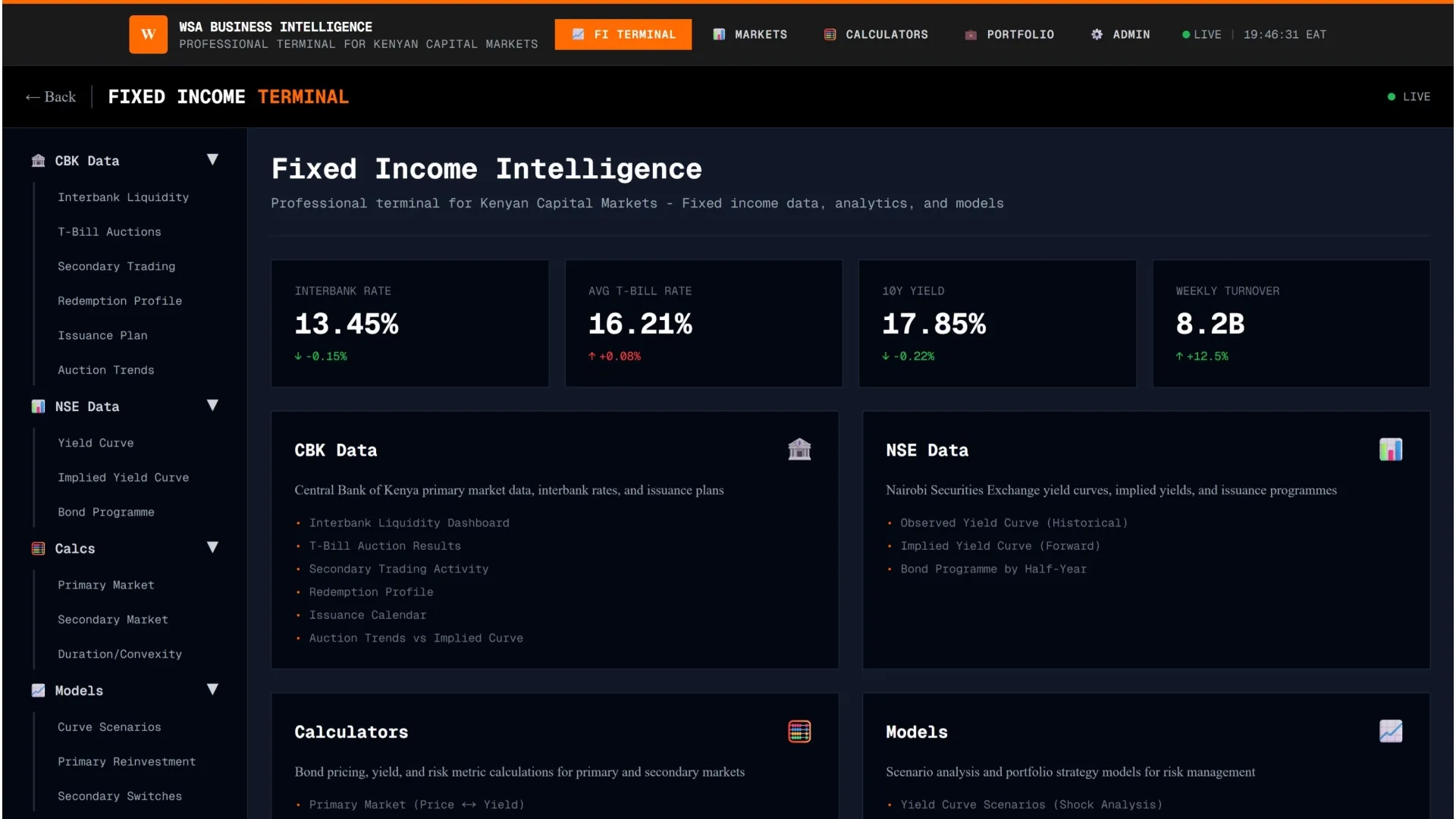
    Fixed Income

    Real-time bond pricing with instant calculations, auction data, yield curves, and trend analysis for Africa’s fixed-income markets.

    Local and Global Insights

    Unique perspective with a blend of local and global news and analysis, tailored for African investors.

    Real-Time Economic Indicators

    Monitor inflation, currency movements, and other key economic indicators for African countries.

    Interactive Data for Local Markets

    Visualize trends and compare markets across Africa with interactive charts and tools.
    Wallstreet Africa
    Wallstreet Africa
    Wallstreet Africa