Sun, 08-Mar 2026

Search news articles
  • Home
  • AllAgricultureBankingAviationEnergyManufacturingTechnologyStartups
  • Geopolitics
  • Kenya Business NewsAfrican Business NewsGlobal News
  • Press Releases
  • Shows
  • Best Places to Work 2026
Subscribe
Events
Subscribe
  • Home
  • AllAgricultureBankingAviationEnergyManufacturingTechnologyStartups
  • Geopolitics

    Contact Us

    Media Queries & Partnerships:[email protected]

    About Us

    We are a leading integrated digital content platform providing in-depth business and financial news across Sub-Saharan Africa & the globe.

    Disclaimer

    The information contained in this website is for general information purposes only.
    © 2026 Wallstreet Africa Technologies LTD.. All Rights Reserved.
    1.0.32

    Based on Data,Expect an increase in Stock Prices on the NSE in January

    The Kenyan
    By The Kenyan Wall Street
    - January 04, 2016
    - January 04, 2016
    Kenya Business news

    It is that time of the year where we sit down and quickly jot down our new years resolutions in the hopes to actually realize them during the year 2016.

    It is also the time when we have literally exhausted our monies on a life of ‘excess’ during the festive period and we are dreading the ‘starvationo’ in the month of January. This comes to show why the January effect would be god sent to you.

    The January effect is a trend in stock prices, especially small cap stocks (price times total number of shares issued), in which stock prices tend to increase in the last trading days of December (pssst!, this means you only have 3 more days to enjoy this phenomena in December) and the first week of January.

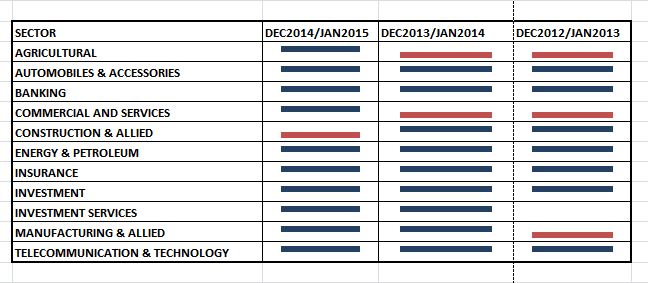
    I conducted a simple analysis of this and found that, on average, in the past 3 years share prices have shot up between the last week of December and the first week of January. This can be seen below:
    trend 1

    Also Read; Top Ten 2016 Resolutions for an ambitious Value Investor

    The blue represents gains while the red represents losses.

    It is a well known fact (and if you did not know, now you know) that Kenya abolished taxes on profit made from the sale of shares and bonds through the Nairobi Securities Exchange (Capital Gains Tax) with effect from January 1, 2016 (if you are not pressed for cash, hold off selling the shares that have realized a positive return and read on to know when to sell).This is meant to boost trading and restore investor confidence in the market.

    I believe that this will further stimulate the January effect as many investors choose to not sell their shares as they will experience a capital gains tax between now and January 1st 2016 on gains made.

    What does this mean for you getting into the market?

    About the Author;

    Stephanie Kimani,Investment analyst and market enthuthiast

    @KimaniStephanie

    The Kenyan Wall Street

    We are a leading integrated digital content platform providing in-depth business and financial news across Africa & the globeSubscribe
    Loading...
    Loading...
    Loading...
    Loading...
    Loading...
    Loading...
    Loading...
    Loading...
    Loading...
    Loading...
    Loading...
    Loading...
    Loading...
    Loading...
    Loading...
    Loading...
    Loading...
    Loading...
    Loading...
    Loading...

    Your edge in markets, powered by AI

    Explore cutting-edge insights with our AI assistant, delivering real-time analysis, personalized news, and in-depth answers at your fingertips.

    Sign Up

    Show me today’s top trades

    Explain the market in simple terms

    What’s my next smart move?

    Report Issue

    Wall Street Africa Business Intelligence

    Access exclusive news, expert analysis, and tools designed to give investors an edge.

    Fixed Income

    Real-time bond pricing with instant calculations, auction data, yield curves, and trend analysis for Africa’s fixed-income markets.

    Local and Global Insights

    Unique perspective with a blend of local and global news and analysis, tailored for African investors.

    Real-Time Economic Indicators

    Monitor inflation, currency movements, and other key economic indicators for African countries.

    Interactive Data for Local Markets

    Visualize trends and compare markets across Africa with interactive charts and tools.
    Wallstreet Africa
    Wallstreet Africa
    Wallstreet Africa