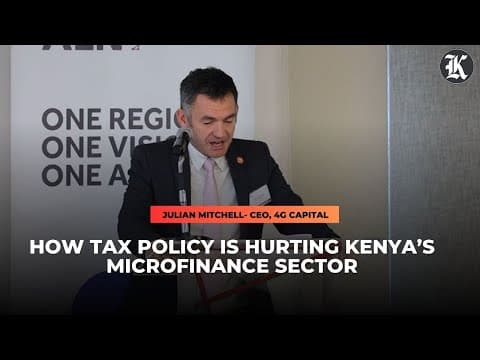
A leading figure in East Africa’s fintech sector has cautioned that Kenya’s unpredictable tax regime is threatening investment, stifling enterprise growth, and eroding the country’s competitiveness as a viable business destination.
- •Julian Mitchell, CEO of 4G Capital, made the remarks at The Kenyan WallStreet’s 2nd Annual Corporate Taxation Roundtable, where he offered an operational perspective from the vanguard of small business lending.
- •The fintech company serves small enterprises across Kenya and Uganda, with a focus on informal traders who often lack access to traditional financial tools.
- •Mitchell argued that inconsistent tax enforcement activities such as retroactive assessments, legal reinterpretations, and burdensome audits have made it harder for businesses in Kenya to operate and scale.
“Tax uncertainty is not the right kind of uncertainty as it deters investment, chokes confidence, and undermines growth of both local and international investment at precisely the moment we need capital most,” Mitchell said during the event, which was attended by among others, Ndiritu Muriithi, Chairperson of the Kenya Revenue Authority (KRA) and Risper Simiyu, KRA’s Commission for Domestic Taxes.
According to Mitchell, these challenges are especially costly for fintechs and microfinance institutions, which are key to driving financial inclusion and job creation in the informal economy. About 30% of Kenya’s GDP and a striking 70% of its jobs come from the informal sector, underscoring its outsize role in the nation’s overall economy.
While Kenya boasts a strong regional position in revenue mobilization due to its highly educated workforce and digital infrastructure, the advantage is being undercut by policy’s divergence from the law. The 4G Capital CEO expressed concern about the growing disconnect between tax enforcement practices and existing legislation.
He said that businesses are being forced to hire expensive legal counsel to navigate tax assessments that often lack a clear statutory basis, consuming management time, resources, and investor confidence.
Mitchell called for a return to core principles of transparency, legal consistency, and engagement with the private sector. He proposed upholding Kenya Revenue Authority’s charter, applying tax laws as passed by Parliament without ad hoc reinterpretation, and creating a formal platform for dialogue between business and policymakers.
“When our cost of compliance rises, we either pass it on to hustlers and traders or scale back investment. Neither option supports Kenya’s long-term prosperity,” Mitchell said.
He further urged Kenya to draw lessons from countries that have successfully fostered investment and growth through stable tax policy. These include European nations like Estonia and Ireland.
Kenya relies on a mix of direct and indirect taxes, with income tax — mostly from formal entities — making up about 45% of revenue. The taxman is facing immense challenges meeting revenue targets as fiscal expenditure surges and additional taxes stir wrath from the Kenyan populace. The KRA has grown more rapacious in its collection efforts but failure to handle businesses with caution could lead to massive closures or downsizing, further inhibiting revenue growth.
By creating an enabling environment for sectors like fintech and microfinance, Mitchell argued that Kenya could unlock broader economic development while avoiding the pitfalls of aggressive revenue collection strategies that damage productivity. He concluded with a call to view tax policy not merely as a tool for state revenue but as a lever for national development.
“We urge the government to align tax enforcement with Kenya’s long-term development goals and build a system that is fair, predictable, and enabling,” he said.